Detection of Diabetic Retinopathy
Apr 22, 2025
Research Paper
Research Spotlight: Deep Learning for Diabetic Retinopathy Detection Using EfficientNet and Swin Transformer
Diabetic Retinopathy (DR) is a leading cause of preventable blindness, especially in underserved communities. This research tackles the challenge of early and scalable DR detection using artificial intelligence. The study presents a rigorous comparison between two cutting-edge deep learning architectures—EfficientNet-B0 (a convolutional neural network) and the Swin Transformer (a vision transformer)—for automated DR grading using the APTOS 2019 retinal fundus image dataset.
Key Findings:
Swin Transformer achieved higher overall diagnostic accuracy (QWK: 0.91), particularly excelling at detecting severe DR stages like proliferative DR.
EfficientNet-B0 demonstrated remarkable precision (98%) for early-stage DR (mild NPDR), with high speed (55 FPS) and low computational demand—ideal for mobile and edge deployments.
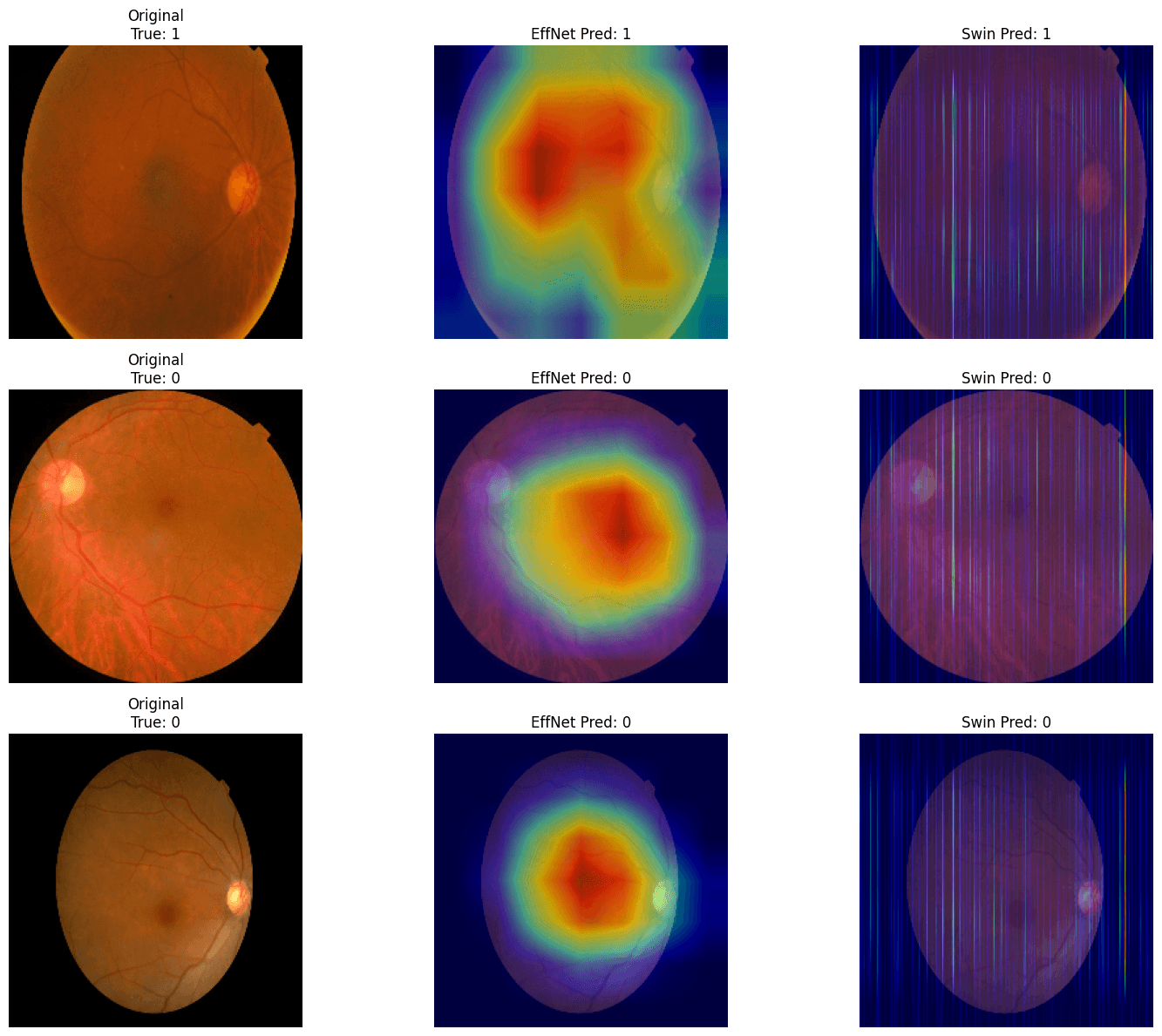
Grad-CAM visualizations revealed architectural differences: Swin-T analyzed global patterns (e.g., vessel structures), while EfficientNet focused on localized features (e.g., microaneurysms).
Clinical Implications:
Use EfficientNet in high-volume, low-resource screening environments (e.g., rural health centers).
Deploy Swin-T in tertiary care hospitals for accurate detection of advanced cases and referral decisions.
Highlights the need for hybrid AI models that combine global and local feature reasoning.
“This work bridges the clinical and technical dimensions of AI, offering a path forward for equitable, scalable, and interpretable diabetic retinopathy screening systems.”
Technical Insights:
Dataset: 3,662 annotated images from the APTOS 2019 competition.
Techniques: Contrast enhancement, Frangi filtering, Grad-CAM explainability, 5-fold stratified cross-validation.
Performance Metrics: QWK, F1-score, ROC-AUC, inference time, and VRAM usage.
Challenges & Future Scope:
Tackled issues like class imbalance and lack of diversity in datasets.
Advocates for multi-ethnic model validation, real-time explainability, and federated learning for ethical and inclusive AI deployment.
Proposed hybrid CNN-Transformer architectures to optimize both accuracy and efficiency.
May 12, 2025
Research Paper